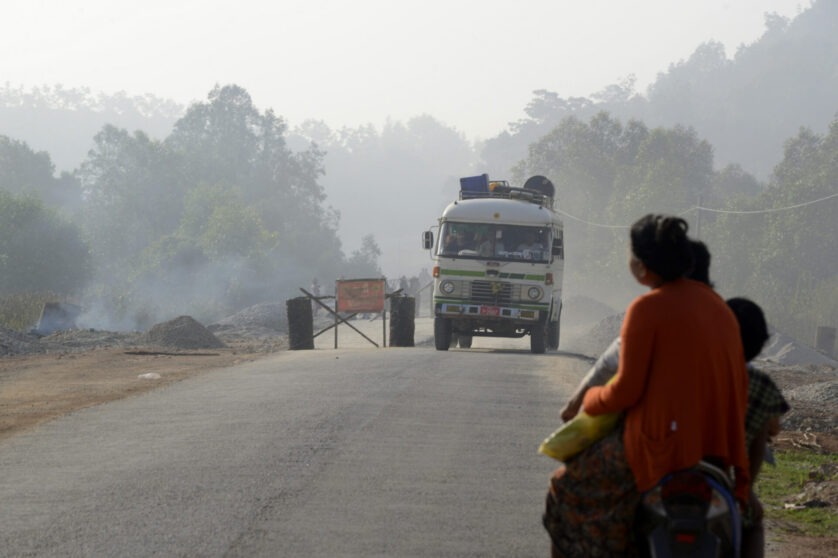
Roadblocks are everywhere in conflict. From Afghanistan to the DRC, from Myanmar to northeast India and the Colombia–Venezuela borderlands, armed groups and security forces routinely stop trucks, tax traders, and control who moves and who doesn’t. Yet for all their ubiquity, checkpoints have remained on the margins of conflict research—treated as a side effect of war rather than a window into how it actually works.
A new special issue in the leading development studies journal Development and Change puts roadblock politics squarely on the academic agenda. Edited by Peer Schouten (Danish Institute for International Studies – DIIS), ICTD Research Fellows Vanessa van den Boogaard and Max Gallien, Shalaka Thakur (DIIS), and Florian Weigand (Centre on Armed Groups/DIIS), the issue brings together eight empirical studies from some of the world’s most contested borderlands, alongside a jointly authored theoretical introduction.
“[R]oadblocks in situations of armed conflict should be an object of study in order to understand broader political, economic and conflict dynamics”, say the co-editors in the special issue’s introductory article.
More than sources of revenue, roadblocks represent control in conflict zone
The central argument is that roadblocks are far more than revenue machines or bureaucratic nuisances. They are a low-cost, versatile tool through which all kinds of actors—militias, governments, insurgencies, and hybrid forces—make and enforce claims to power. Because roadblocks sit at the intersection of movement and authority, they offer a uniquely direct view of who controls what in a conflict zone: not necessarily territory, but, perhaps more critically, flows – of goods, money, and people. The editors call this the “politics of passage.”
The individual articles show just how much can be learned by following what happens at a roadblock.
The politics of passage: what does research teach us about roadblocks and authority?
To launch the special issue, ICTD hosted a webinar with the series’ co-editors and contributors. The event first presented the principal argument from each paper (see below) and then reflected on the policy implications through the contributions of Laura Saavedra-Lux, Research Associate at UNU-WIDER, and Jonathan Somer, Legal Advisor at the Danish Red Cross.
- In Afghanistan, checkpoints proved central to the rise and fall of neo-patrimonial power under Karzai and Ghani, and to the Taliban’s insurgent revenue strategy.
- In Myanmar after the 2021 coup, the junta and resistance forces set up rival checkpoint systems, with the junta’s arbitrary extortion inadvertently strengthening local self-reliance and the resistance. In Shan State, a close look at the opium trade reveals why armed groups often struggle to profit from lootable resources: the challenge isn’t finding the drugs, it’s controlling the mountain paths along which they travel.
- Along the Colombia–Venezuela border, the closure of the official crossing pushed smuggling networks into a new political economy of state–crime cooperation.
- In Iran’s Kurdish borderlands, ethnographic research reveals the small-scale tactics smugglers use to negotiate—or evade—checkpoints operated by both the state and armed groups.
- Northeast India, meanwhile, shows how checkpoints are better understood as relational sites that crystallise wider power dynamics than as isolated chokepoints.
- Finally, in Somalia, roadblocks are enmeshed in the struggle over trade rents between and within clans—while intensifying the stakes of differentiation between clan groups.
Watch the webinar:
Taken together, the issue makes the case that studying checkpoints is not a niche empirical exercise—it is a way into the most fundamental questions about how authority, revenue, and violence interlock in conflict-affected settings. In doing so, it establishes checkpoint research as a distinct and theoretically grounded academic field.
The special issue grows out of the Roadblocks and Revenues working paper series. It is the result of a collaboration between ICTD, DIIS, and the Centre on Armed Groups, funded by the Carlsberg Foundation (TRADECRAFT).
ICTD’s work on conflict and informality
Looking at conflict areas has long been part of ICTD’s substantive work on informality and tax, currently led by Gallien and van den Boogaard. This area of ICTD research aims to map the extent, composition, and experiences of “tax-like” payments that lie outside of statutory laws, and to understand their implications for livelihoods, fiscal decentralisation, service delivery, and broader local governance reform.
See ICTD’s previous work related to conflict and informal taxation.
Segments of this news story were first published by the Danish Institute for International Studies.