Across the Gambia, as in many lower-income countries, the informal sector plays a substantial role in livelihoods and economic activity, making up approximately 82 per cent of total employment. How governments engage with this part of the economy raises important questions around tax policy, equity, and administration.
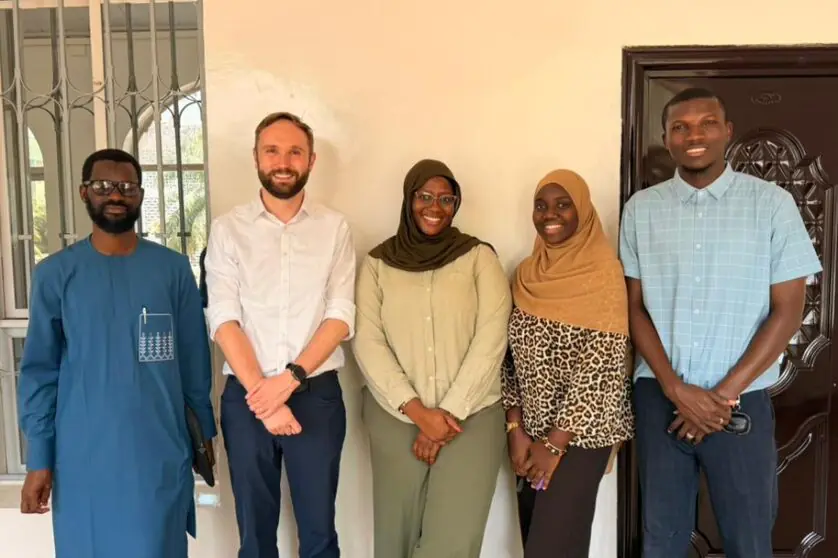
Earlier this month, the International Centre for Tax and Development (ICTD) convened a stakeholder workshop in collaboration with the Gambia’s Ministry of Finance and Economic Affairs (MOFEA) to discuss evidence-informed options for reforming the country’s approach to informal sector taxation.
The workshop brought together around 12-16 from across government and municipal bodies. A key focus of the discussion was the value of bringing actors who do not normally engage with one another into the same room, reflecting a common challenge of limited coordination and dialogue between institutions involved in informal sector governance.
The activity forms part of a new partnership between ICTD and MOFEA, formalised through a recently signed memorandum of understanding, which sets out a shared commitment to using research to inform tax policy decisions.
Dr Max Gallien, ICTD Research Fellow, who led the workshop on behalf of ICTD, said:
“It was a real pleasure to be in The Gambia for this workshop. I spend a lot of my time advocating for the role of evidence in policy, so it was refreshing to walk into a room where that conversation was already well underway. There’s a strong team here, and a lot of good ideas, and I’m very much looking forward to seeing where this collaboration goes.”
ICTD’s research and engagement on informal sector taxation
Informal sector taxation has been a longstanding focus of ICTD’s research and policy engagement. Evidence from this work shows that, across many lower-income countries, informal workers and businesses are often subject to a range of formal and informal payments – contrary to common assumptions. This raises important questions about fairness, effectiveness, and how tax systems function in practice.
To support more evidence-based discussion on these issues, ICTD works with policymakers, researchers, and civil society organisations across regions, and in 2025 launched a Community of Practice on Informality and Tax. The initiative provides a forum for shared learning and exchange, drawing on research and country experience to inform ongoing policy debates. The stakeholder workshop in The Gambia contributes to this wider body of work, responding to policy questions identified by national partners.
Visit this webpage to know more about our work on informality and tax.