Policy Brief 14

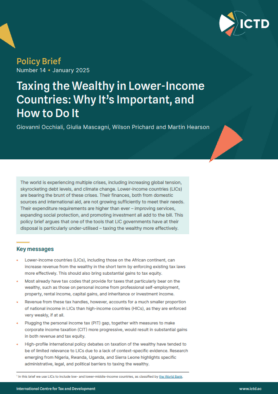
The world is experiencing multiple crises, including increasing global tension, skyrocketing debt levels, and climate change. Lower-income countries (LICs) are bearing the brunt of these crises. Their finances, both from domestic sources and international aid, are not growing sufficiently to meet their needs. Their expenditure requirements are higher than ever – improving services, expanding social protection, and promoting investment all add to the bill. This policy brief argues that one of the tools that LIC governments have at their disposal is particularly under-utilised – taxing the wealthy more effectively.

Key messages

  1. Lower-income countries (LICs), including those on the African continent, can increase revenue from the wealthy in the short term by enforcing existing tax laws more effectively. This should also bring substantial gains to tax equity.
  2. Most already have tax codes that provide for taxes that particularly bear on the wealthy, such as those on personal income from professional self-employment, property, rental income, capital gains, and inheritance or investment income.
  3. Revenue from these tax handles, however, accounts for a much smaller proportion of national income in LICs than high-income countries (HICs), as they are enforced very weakly, if at all.
  4. Plugging the personal income tax (PIT) gap, together with measures to make corporate income taxation (CIT) more progressive, would result in substantial gains in both revenue and tax equity.
  5. High-profile international policy debates on taxation of the wealthy have tended to be of limited relevance to LICs due to a lack of context-specific evidence. Research emerging from Nigeria, Rwanda, Uganda, and Sierra Leone highlights specific administrative, legal, and political barriers to taxing the wealthy.
  6. Problems, including insufficient data (or lack of data sharing), weak compliance strategies, and political interference with enforcement, are generally entrenched in all LICs.
  7. African LICs have experimented with strategies to tax the wealthy effectively more than is appreciated. These include the creation of dedicated high net worth individual (HNWI) units, adoption of taxpayer clearance certificates, and the establishment of cooperative compliance frameworks.
Authors

Giovanni Occhiali

Giovanni Occhiali is a Development Economist based at the Institute of Development Studies, where he works on a number of projects related to Tax Administration and Compliance, Tax and Governance and co-leads ICTD’s capacity building programme together with Dr Max Gallien. His research focuses on Sub-Saharan Africa, and outside of the field of taxation his main interests are energy economics and industrial policies. He holds a PhD from the University of Birmingham and prior to joining ICTD, he was a Researcher at the Fondazione Eni Enrico Mattei and an Overseas Development Institute Fellow at the National Revenue Authority of Sierra Leone.

Giulia Mascagni

Giulia Mascagni is a Research Fellow at the Institute of Development Studies and Executive Director of the ICTD. Her main area of work is taxation, but she also has research interest in public finance, evaluation of public policy, and aid effectiveness. She is an economist by training, holding a PhD in Economics from the University of Sussex. Her main geographical interest lies in African countries, with a particular focus on Ethiopia and Rwanda.

Wilson Prichard

Wilson Prichard is an Associate Professor at the University of Toronto, an Associate Research Fellow at the Institute of Development Studies, Chair of the Local Government Revenue Initiative (LoGRI) and former Executive Director of the International Centre for Tax and Development (2020-2024). His research focuses on the relationship between taxation and citizen demands for improved governance in Africa.

Martin Hearson

Martin Hearson is a Research Fellow at IDS, Research Director of the ICTD and the International Tax programme lead. His research focuses on the politics of international business taxation, and in particular the relationship between developed and developing countries. Before joining ICTD, Martin was a fellow in international political economy at the London School of Economics and Political Science, teaching courses on political economy and global financial governance.
Cette publication est disponible en français
Download
Privacy Overview

This website uses cookies so that we can provide you with the best user experience possible. Cookie information is stored in your browser and performs functions such as recognising you when you return to our website and helping our team to understand which sections of the website you find most interesting and useful.