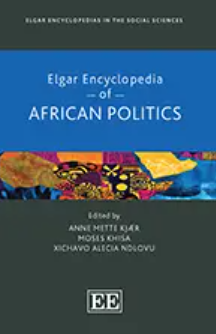
Elgar Encyclopedia of African Politics Chapter 82: Taxation and state-building
Share
HomePublicationsElgar Encyclopedia of African Politics Chapter 82:…
Taxation is a fundamental function of the state and a critical marker of state power. This entry examines taxation’s role as a central component of state-building, serving both as a resource for state functions and as a mechanism for state–society interactions. Historically, taxation was driven by the necessities of conflict, particularly in early modern Europe where taxation helped consolidate state institutions and administrative capacities. However, the unique circumstances of taxation in Africa and the varied nature of taxation systems during both pre-colonial and colonial eras mean that theories of tax and state-building originating in early modern Europe do not necessarily apply. Contemporary challenges in lower-income countries, including economic globalisation and the perverse legacies of colonialism, complicate traditional theories of tax and state-building in the African context. Additionally, the role of informal and non-state taxation shapes political orders and authority beyond traditional state mechanisms.
Vanessa van den Boogaard is a Research Fellow at ICTD and a Senior Research Associate at the Munk School of Global Affairs and Public Policy at the University of Toronto. She completed her PhD thesis on informal revenue generation and statebuilding in Sierra Leone, and has ongoing research on the topic in the Democratic Republic of the Congo, Ghana, and Somalia. Vanessa co-leads ICTD's research programme on informality and tax.
Tanya Bandula-Irwin is an incoming SSHRC Postdoctoral Fellow at Northwestern University and a postdoctoral researcher with ICTD, specialising in the political economy of conflict, governance, and taxation. Her research examines how armed groups develop taxation and financing systems, their relationships with civilians, and the broader implications for state-building and governance. She has conducted field research in the Philippines and Somalia, exploring citizen-led financing for development and how local communities mobilize resources to fill governance gaps. Her PhD dissertation analysed the taxation practices of armed groups in the Philippines. Her work has been supported by the International Development Research Centre, the Social Sciences and Humanities Research Council of Canada, and the Department of National Defence and has been published in Studies in Conflict & Terrorism, Journal of Eastern African Studies, PS: Political Science & Politics, and UBC Press.
Citation: van den Boogaard, V. and Bandula-Irwin, T. (2026) Taxation and state-building. In: Kjær, A.M., Khisa, M. and Ndlovu, X.A. (eds), Elgar Encyclopedia of African Politics. Cheltenham: Edward Elgar Publishing. DOI: 10.4337/9781035309306.00088