How effective are the most common approaches to taxing informal sectors? What does the available evidence tell us about their implications for revenue administration, efficiency, and equity? What are the key issues to consider for reform or for developing new approaches?
The informal economy is often framed as an untapped source of tax revenue, and governments frequently prioritise its taxation as a means to broaden the tax base. Yet approaches such as simplified tax regimes and mass registration campaigns have shown weak performance in revenue collection and raised questions about fairness and equity.
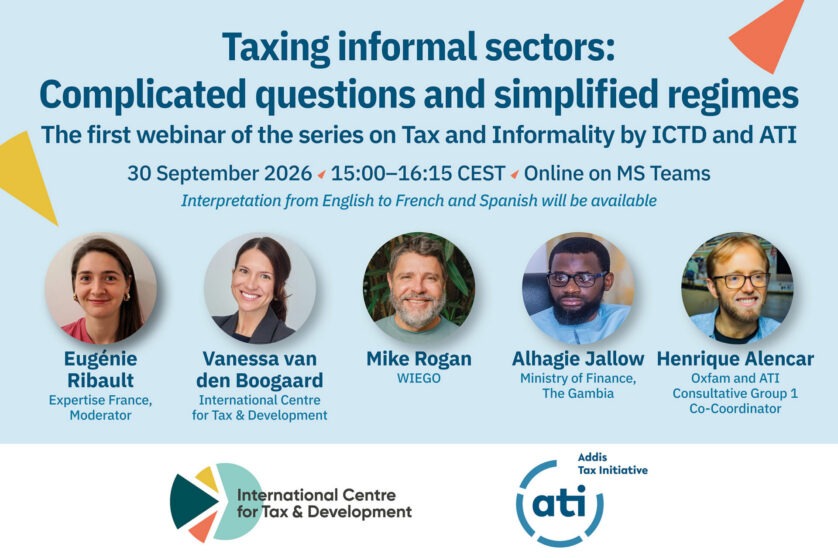
This webinar, co-hosted by ICTD and the Addis Tax Initiative (ATI), will provide a wider introduction to recent research and evidence on taxation of informal sectors in lower-income country contexts. The first of a three-part series, it will draw on recent studies from various country contexts with a focus on policy relevance and the key questions that revenue administrations face in relation to taxing the informal sector. The discussion will include perspectives from researchers, policymakers, and civil society working actively in this area.
Speakers
- Vanessa van den Boogaard, Senior Research Fellow (ICTD)
- Mike Rogan, Research Associate (WIEGO) and Associate Professor in Economics (Rhodes University, South Africa)
- Alhagie Jallow, Director of Revenue and Tax Policy (Ministry of Finance, The Gambia)
- Henrique Alencar, Consultative Group 1 Co-Coordinator (Oxfam and ATI)
Eugénie Ribault (Expertise France) will moderate the session.
About the Tax and Informality webinar series
Under Action 1 of the ATI Seville Declaration on Domestic Revenue Mobilisation, ATI members have committed to support domestic revenue mobilisation on the basis of fair, gender-responsive and environmentally sensitive tax policies, as well as fair, efficient, effective and transparent revenue administrations.
Within the framework of Action 1, the collaboration between ICTD and ATI provides an opportunity to facilitate dialogue on how tax administrations can engage with informality in ways that support fair and effective domestic revenue mobilisation.
The webinar series, planned for the last quarter of 2026, consists of three webinars addressing key topics including taxation of informal sectors, targeting higher-income operators in the informal sector, and alternative approaches to broadening the tax base. The series will build on ICTD’s Tax and Informality Community of Practice and draw on existing discussions and priorities to identify relevant topics for continued exchange.