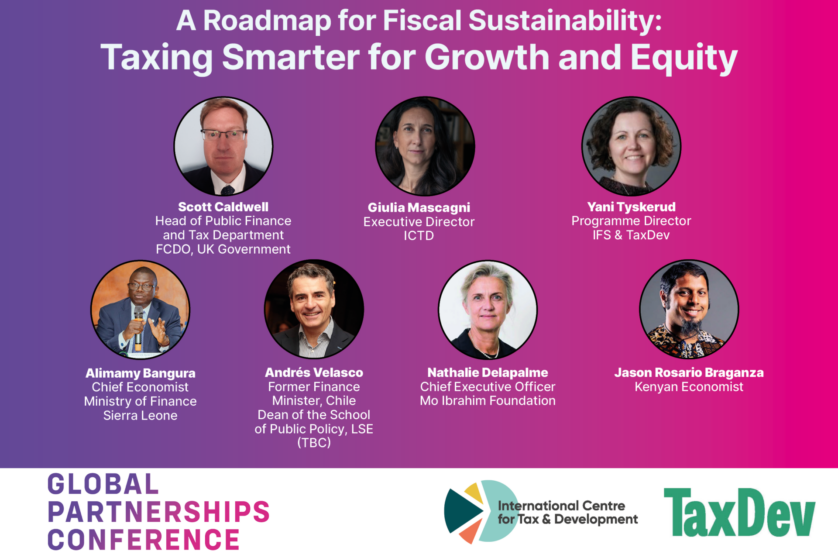
The UK is cohosting on 19-20 May the Global Partnerships Conference, a major summit on the future of international development to drive shared growth and prosperity and tackle global challenges head on.
Organised on the sidelines of the Conference, our side event will provide practical lessons drawn from research on tax reform in lower-income countries. It will focus on how reforms can be effective at scaling tax revenues, as well as being equitable and sustainable.
Boosting fiscal resilience in lower-income countries has acquired a renewed urgency in the new reality of development finance. While aid decreases substantially, many lower-income countries also face pressing debt servicing costs that exceed what they can spend on basic services for their citizens.
Navigating the next era of development requires a new paradigm grounded in resilience, self-reliance, and partnership. Taxation is key to getting this right. While low and middle-income countries collect at least $1.5 trillion in tax revenue, this is still nowhere near the $4 trillion required to plug the financing gap toward the SDGs. It is impossible to conceive of a more self-determined development model in which tax does not play a larger role. When they are ineffective or inequitable, however, efforts to raise more revenue can undermine tax collection and public trust.
The challenge is massive, but we have a clear roadmap: more than a decade of context-specific evidence, much of which has been generated through partnerships between revenue authorities, civil society associations, finance ministers and researchers in the UK and across the globe. These partnerships enable officials and researchers to leverage data, share skills, jointly identify key insights, and embed learning feedback loops in real-time.
Objectives of the side event
- Emphasise the role of public revenue mobilisation as a key enabler of fiscal resilience, growth, and equity.
- Highlight practical cases in which co-created evidence and partnerships led to tangible improvements in tax systems.
- Demonstrate how co-produced, data–driven analysis can unlock new insights and innovations in tax system design and delivery.
- Illustrate and discuss the role of external partners in securing fiscal resilience through domestic revenue mobilisation.
Moderator
Scott Caldwell, Head of Public Finance and Tax Department, FCDO, UK Government
Panellists
- Giulia Mascagni, ICTD Executive Director
- Yani Tyskerud, Programme Director, ODI Global & TaxDev
- Andrés Velasco, Dean of the School of Public Policy at LSE, former Minister of Finance of Chile (TBC)
- Alimamy Bangura, Chief Economist, Ministry of Finance, Sierra Leone
- Nathalie Delapalme, CEO, Mo Ibrahim Foundation
- Jason Rosario Braganza, Kenyan Economist, Incubator of the ‘Fikra’ Initiative
Other events

Talking Head | The Hidden Billions: Rethinking Tax Expenditures for Sustainable Financing
What if one of the biggest opportunities for sustainable financing lies not in raising new taxes but in better managing the ones we forgo?
Tax expenditures — such as exemptions, deductions, and preferential rates — cost governments around 3.7% of GDP and nearly a quarter of total tax revenues. Yet, they remain poorly governed and weakly scrutinised. In a context of tight fiscal space and rising investment needs, this is a critical missed opportunity.
This talk introduces the work of the Coalition on Tax Expenditure Reform (COATE), a global, multi-stakeholder initiative launched in 2025 under the Sevilla Platform for Action. The core message is simple but urgent:
- Tax expenditures represent a major source of forgone revenue
- Reform requires better data and transparency
- There is an immediate opportunity to act, by developing and adopting voluntary international standards for reporting.
This is not about eliminating tax incentives, but about making them work better. Drawing on new global evidence and policy momentum — from the Sevilla commitments to ongoing G7 discussions — this talk will show why better reporting is one of the most practical, cost-effective and high-impact step governments can take to strengthen domestic revenue mobilisation and free up resources for sustainable development. At a moment when every dollar counts, the question is no longer whether we can afford to reform tax expenditures, but whether we can afford not to.
Speaker
Alexandra Readhead, Director, Tax and Sovereign Debt, IISD
Date and time
Wednesday 20 May at 11:00 – 11:20 a.m.
IDS side event | Shifting the Power: Global South Perspectives on Future Purposes of Development Cooperation and New Partnership Approaches
The Institute of Development Studies (IDS), home of the International Centre for Tax and Development, is hosting a side event on Shifting the Power: Global South Perspectives on Future Purposes of Development Cooperation and New Partnership Approaches
New actors, shifting alliances, and geopolitics are reshaping long-standing norms of development cooperation. Expectations are growing that development will become more inclusive, impactful and more sustainably financed. Amidst competing visions for the future and diverse views on how to make tangible progress, actors across the Global South are articulating their views on the purposes and partnerships that drive development cooperation, and how we can ensure the priorities of those most affected by development challenges guide and shape agendas and decision-making.
With conversations and initiatives on the future of development kicking into high gear, this session will aim to put the perspectives of Global South countries at the heart of what comes next. The event will showcase findings from research conducted by Southern Voice, the Institute for Development Studies and the OECD’s Future of Development Conference on those perspectives and bring together leaders from across the development ecosystem for a discussion on how to embed them through ongoing processes. With participants contributing from a range of global contexts, it will identify practical steps to action these insights and build new types of power-shifting partnerships.
Speakers
- Peter Taylor, IDS Research Fellow
- Katharina Stasch, Permanent Representative of Germany to the United Nations Office at Geneva
- Carsten Staur, Chair, OECD’s Development Assistance Committee (DAC)
- Susan Brown, Assistant Secretary General, Assistant Administrator and Director of the Bureau of External Relations and Advocacy, UNDP
- Ms Macenje ‘Che Che’ Mazoka, High Commissioner of Zambia
- Alexia Latortue, Future of Development Cooperation Coalition (TBC)
- Representative of Bangladesh (TBC)
- Representative of France (TBC)
- Representative of Jamaica (TBC)
- Representative of South Africa (TBC)
Date and time
Wednesday 20 May at 3:00 – 4:00 p.m.
Blog series
Ahead of the Conference, IDS experts looked at primary issues on the agenda and what needs to be addressed to tackle global challenges in this new era of development — including on the importance of ‘getting tax right’. Visit this webpage to read more analyses.
Meet our team
Connect with the members of our team who will be participating in the conference:
- Giulia Mascagni, Executive Director
- Martin Hearson, Director of Research
- Giovanni Occhiali, Research Fellow and lead on taxing the wealthy and Climate and Environmental Tax
- Emilie Wilson, Head of Communications and Impact
- Stephanie Alkoussa, Communications Officer