For many years, Pakistan has faced an uphill struggle to increase revenue collections – even within the formal economy tax compliance has long been subdued, partly explaining the country’s low tax: GDP ratio, which was only 10.8 percent in 2024.
With support from the REMIT programme, Pakistan’s Federal Board of Revenue is deploying new technologies to try and boost collections, and Digital Eye is leading the way.
Digital Eye is a low cost but effective approach to monitor production for all producers in an industry – in this case cement. Cement is big business in Pakistan, with sales registered at US$ 3.7 billion in 2024, but there have long been concerns that manufacturers have been under-reporting production so to lower their Federal Excise Duty and Sales Tax liabilities.
From risk-based audits to real-time production monitoring
In a world where much focus is on risk-based approaches to compliance, with audits and physical verification limited to a small percentage of unlucky taxpayers, Digital Eye complements this model by tracking all production across every firm within an industry.
The falling cost of technology now makes this method practical for a growing number of sectors.
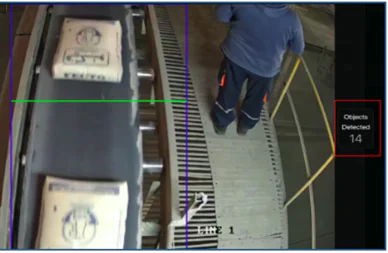
There are 26 cement plants in Pakistan, totalling 220 production lines each producing thousands of 50kg bags of cement each day. Pakistan’s Federal Board of Revenue (FBR) have linked cement firms’ existing camera feeds to a computer application that counts each and every bag of cement, 24 hours a day. The count data is sent directly back to the FBR over the internet, and the cement firms have access to this data, so when they report their production numbers in their monthly sales tax return, they know what count data has already been sent to the revenue authority.
How Digital Eye uses machine learning to track cement production
The process makes use of YOLO machine learning software. YOLO, or You Only Look Once, is a family of object detection models that learn what to count from simple user direction. This video shows the process in action.
Although the underlying technology is sophisticated, implementation is straightforward. FBR staff require only minimum training to connect camera feeds and configure the counting system. No coding or artificial intelligence expertise is needed.
The total cost per production line of installing and operating Digital Eye is less than US$ 1,200. Despite this low cost the software operates with a high level of precision – with accuracy levels of between 99 and 99.7% being achieved in counting cement bags on active production lines. These are higher levels of accuracy than those achieved with a human armed with a clicker. The high accuracy rates were achieved through practical adjustments to camera placement, lighting conditions, and system configuration. Performance was validated during live factory operations rather than controlled testing environments.
Treating everyone the same
A key advantage of installing Digital Eye for all manufacturers is that, unlike when a firm is chosen for special attention or an enhanced audit, firms feel like they are being treated the same as everyone else. Universal application also gives reassurance that firms’ competitors aren’t cheating the system for unfair advantage. There are even spin-off benefits for the national statistics authority who now have a timely and reliable data source to feed into their monthly manufacturing and GDP statistics.
From a legal perspective, the system builds on existing powers. Under Pakistan’s Sales Tax Act, the FBR already has the legal authority to place revenue officers on production lines – the digital monitoring of camera feeds is an extension of this legal provision.
A very high return on investment: boosting tax revenue at low cost
The initial results from Digital Eye are encouraging. After years of decline, recorded cement production has started to increase, with 2025 output 6.2% higher than 2024.
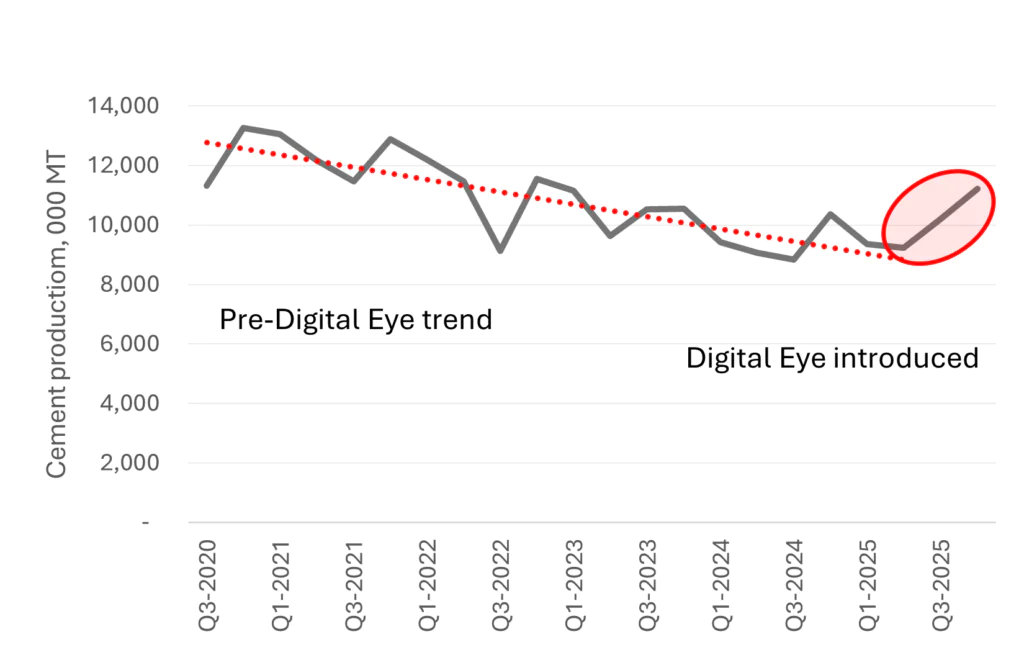
Whilst the upturn could be down to a number of factors, at face value this increase has led to an extra US$ 42 million in sales tax in 2025 – against a total installation cost of only ~US$ 260,000, a revenue yield 150 times the original investment!
Digital Eye is now being rolled out to the sugar sector, with 303 production lines covered and early estimates showing a 50 percent increase in revenue collections. Other industries are also being considered, including steel production, fertilizer, textiles, floor tiles, and soft drinks.
Pakistan isn’t the only country dealing with under-reporting, and this technology could make a real difference elsewhere too – helping modernize and digitize tax systems, treat taxpayers more fairly, and do it all at a surprisingly low cost.
About the REMIT programme and Digital Eye technology
How Digital Eye Works
- Video Capture at Factory Site – Cameras installed along production lines capture real-time footage of cement bag movement.
- On-Site Processing and AI Detection – Video feeds are processed locally using machine-learning models to detect and count production units.
- Data Storage and Transmission – Processed production data is stored locally and securely transmitted to FBR systems.
- Central Aggregation and Analysis – Data is received at FBR headquarters, where it is aggregated and analysed through a central database and analytics engine.
- Alerts and Notifications – Automated alerts are generated where anomalies or discrepancies are detected.
- Role-Based Dashboard Access – Authorised users (central administrators, factory managers, and operators) access dashboards and reports based on defined roles.
About REMIT Pakistan
This blog was written by a team from REMIT Pakistan. The REMIT programme stands for Revenue Mobilisation, Revenue and Trade – it is a five-year technical assistance programme funded by the Foreign, Commonwealth & Development Office (FCDO), United Kingdom to support Pakistan in implementing strategic reforms in the realm of economic development, trade, investment and revenue mobilisation. The initiative implemented by Adam Smith International.
Check more of ICTD’s work on digitalisation:
- Blog – Why digitalisation alone won’t fix Africa’s tax systems: 6 steps for real impact
- Blog – From Identification to Stronger Tax Administration: Can Digital IDs Deliver?
- Blog – Tax incentives for digital payments – Lessons for African tax administration organisations
- Policy brief: Digital public infrastructure and tax: strengthening state capacity with shared digital rails