For years, my work in tax justice advocacy and accountability, as well as in policy making and monitoring in Kenya, exposed me to the everyday realities of how taxation affects people’s lives. Yet, I always felt there was a missing link: locally grounded academic research that informs evidence-based decisions. It was this need for deeper understanding that motivated me to join the ICTD Research on Tax and Development Course in 2023.
I enrolled with one major objective: to translate and deepen my practical experience through research based on strong academic methods. On this front, the course did not disappoint.
Mentorship and peer learning in tax and development
What stood out to me was the way the course seamlessly connected practice with academic rigour. It wasn’t just about learning research tools; it encouraged us to take ownership of our ideas while knowing our mentors were fully invested in our progress. The cohort itself, made up of practitioners and early-career researchers from across Africa and beyond, became an unexpected source of motivation. This environment prompted me to confront something I had been postponing for years: committing to a PhD.
As the course wrapped up in Accra with an in-person training session, I asked one of my mentors whether the draft proposal I had submitted as part of the training could qualify as PhD material. His response was forthright: “It is certainly, and you are too, I do not doubt that”. At that point, I knew I had made the right decision.
My “aha” moment had come, not quite like a “eureka!” but more like a challenge taken with renewed confidence. My PhD journey had begun.
Researching debt, taxation and State legitimacy in Kenya
Still in Accra, motivated by my mentor’s encouragement, I immediately started searching for universities that were still accepting PhD applications aligned with my research interests. After several applications, I received an offer from the University of Johannesburg in February 2025, along with a partial supervisor-linked bursary.
Over the last 11 months, I have developed and presented my PhD research proposal on Debt, Taxation and State Legitimacy in Kenya. This research area is derived from a combination of factors: a research gap identified through my work experience, my long-standing interest in tax justice, the analytical skills acquired from the ICTD course, and Kenya’s recent political and economic events that pushed public resistance to unfair taxation into the spotlight.
From tax policy to protests: unpacking Kenya’s triple problem
As I dug deeper into the relationship between debt, taxation and state legitimacy, three interconnected challenges emerged. Together, they form what I call Kenya’s “triple problem”:
- a high risk of debt distress,
- increasing pressure to raise taxes (ordinary revenue), and
- eroding state legitimacy.
Indeed, Kenya faces ballooning debt, intense pressure to generate revenue to service this debt, shrinking fiscal space, and reduced financing for social services and development. On the other hand, government attempts to widen the tax base and to increase tax rates are increasingly met with public resistance. This is what primarily triggered the 2024 Gen-Z anti-Finance Bill protests. This resistance is further bolstered by reduced access to social services due to the increased cost of living, high levels of youth unemployment and a slowdown in economic activities.
Under these circumstances, additional taxation can feel like “squeezing more milk from an already underfed cow”; a strategy that is both unsustainable and counterproductive. Pushed against the wall, citizens have no option but to push back. My research seeks to understand how these dynamics affect people’s perceptions of the state and what this means for designing fairer, more legitimate tax systems.
Joining global dialogue on tax justice and fiscal policy
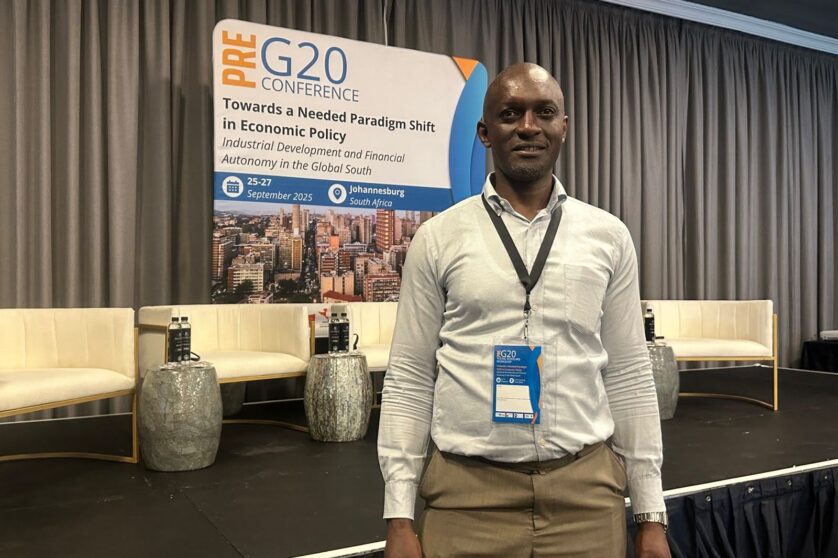
As part of my PhD studies and research capacity development, I took part in several conferences. These include the International Development Economics Associates (IDEAs) Young Scholars Workshop, and the IDEAs Pre-G20 Global Conference: Towards a Needed Paradigm Shift in Economic Policy: Addressing Industrial Development and Financial Autonomy in the Global South. I also presented a paper titled “Are Debt-For-Climate Swaps a Viable Solution in Kenya?” at a conference hosted by Tax Justice Network on “A Climate for Change: Towards Just Taxation for Climate Finance”. Drawing on Kenya’s recent debt-for-climate agreement with Germany and the country’s ongoing soil carbon credit projects, the paper examines whether debt-for-climate swaps offer a viable option for reducing Kenya’s debt burden.
These engagements have tested and strengthened my commitment to academic research and discourse. They have also reminded me how important it is to connect research to lived realities, a lesson reinforced throughout the ICTD course.
Looking ahead: advancing fair taxation
As I continue my PhD journey, I remain deeply motivated by the same conviction that led me to apply for the ICTD course in the first place: that better research can support more just and effective tax systems. I hope that my work on debt, taxation, and legitimacy in Kenya will contribute to broader discussions on how states can raise revenue in ways that strengthen – not undermine – their social contract with citizens.
Looking ahead, I am convinced I made the right decision. For anyone beginning this journey from where I once stood, I would say that genuine commitment, in line with the rigour the course demands, is key to achieving your objective. Make sure to build both a social and academic support network while at it. This may sound like an overstatement, but Mandela’s words ring true: “It always seems impossible until it is done”.
Whether you are pursuing further study, publishing your work, or applying your skills in practice, your experience on the course is a foundation to keep building on. Stay in touch, keep learning, and keep pushing the boundaries of African-led research.