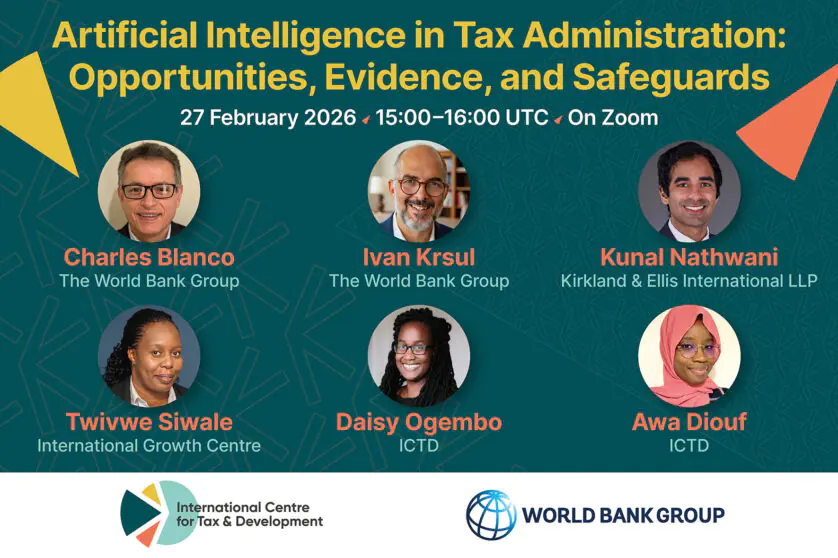
Artificial Intelligence (AI) and advanced data analytics are rapidly transforming tax administration worldwide. Revenue authorities are deploying AI tools for risk profiling, audit selection, compliance management, and service delivery, with the promise of improving efficiency and strengthening domestic revenue mobilisation. For lower-income countries, including across Africa, these technologies offer potential gains at a time of fiscal pressure and expanding data availability.
At the same time, AI adoption raises significant economic, legal, and governance challenges. Algorithmically informed decisions can affect taxpayer rights, reshape enforcement priorities, and test existing accountability mechanisms. Questions of transparency, bias, explainability, legal oversight, and institutional readiness are particularly important where regulatory and administrative safeguards are still evolving.
This webinar brings together global policy experience, new empirical research from Africa, and legal scholarship to explore how AI can be adopted responsibly in tax administration.
The discussion will:
- Examine how AI is currently being used or considered in tax administration.
- Share preliminary empirical evidence from African country contexts.
- Explore the institutional conditions required for effective AI deployment.
- Consider the legal and governance safeguards necessary to protect taxpayer rights and maintain legitimacy.
Speakers
- Awa Diouf, ICTD
- Charles Blanco, The World Bank Group
- Ivan Krsul, The World Bank Group
- Kunal Nathwani, Kirkland and Ellis International LLP
- Twivwe Siwale, International Growth Centre
The webinar will be moderated by Daisy Ogembo, Research Fellow at ICTD.