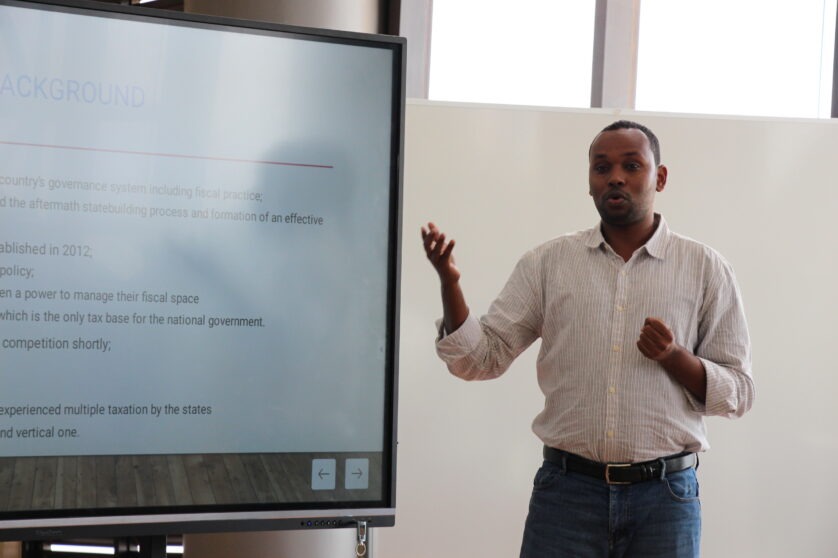
We sat down with Najibullah Nor Isak, a 2021-2022 alumnus of the ICTD Research on Tax and Development course, to discuss his remarkable career trajectory in Somalia’s Ministry of Finance, his efforts to modernise the country’s tax system, and his vision for establishing Somalia as a financially independent nation. Given that Somalia collects only about 3% of GDP in revenue – one of the lowest rates in the world and far beneath regional averages – his work has become even more urgent. Indeed, Najibullah’s work has contributed to an 80% increase in domestic revenue. He speaks about this and much more in this interview.
Stephanie: You were already working in the taxation area at the Ministry of Finance before you applied for the course. What motivated you to seek additional training with ICTD?
Najibullah: Somalia is still a heavily aid-dependent country, and I felt I needed stronger research skills to understand our tax gaps, identify weaknesses in different revenue streams, and contribute more meaningfully to policy.
I also wanted to understand why Somali citizens historically resist taxation. Tax collection has often been coercive, and public services have not reflected what people pay. To respond to these realities, I needed proper training in research and data analysis.
I was then put in touch with ICTD Research Fellow, Vanessa van den Boogaard, who encouraged me to apply. When I saw the course content, I knew it was exactly what I was looking for.
Stephanie: What were the major takeaways from the course?
Najibullah: The course gave me the tools to contribute effectively to major policy discussions, enhancing both my quantitative and qualitative data analysis skills. It also strengthened my research mindset, increasing my value in policy analysis and in identifying tax compliance gaps.
For example, after the course, I played a key role in developing Somalia’s Medium-Term Revenue Roadmap (2024–2027), a national strategy to expand domestic revenues and reduce dependence on foreign aid.
Stephanie: You later went on to co-author a paper with Vanessa. How did that collaboration begin?
Najibullah: It started in 2020, when Vanessa interviewed me for a project on taxation in Somalia. After reading some of my earlier work, she suggested we collaborate on a study on the political economy of taxation and conflict. Working on the research strengthened my analytical skills and deepened my commitment to studying Somalia’s tax system. The paper was eventually published in January this year.
Stephanie: What impact did that publication have on your career and your work in the Ministry of Finance?
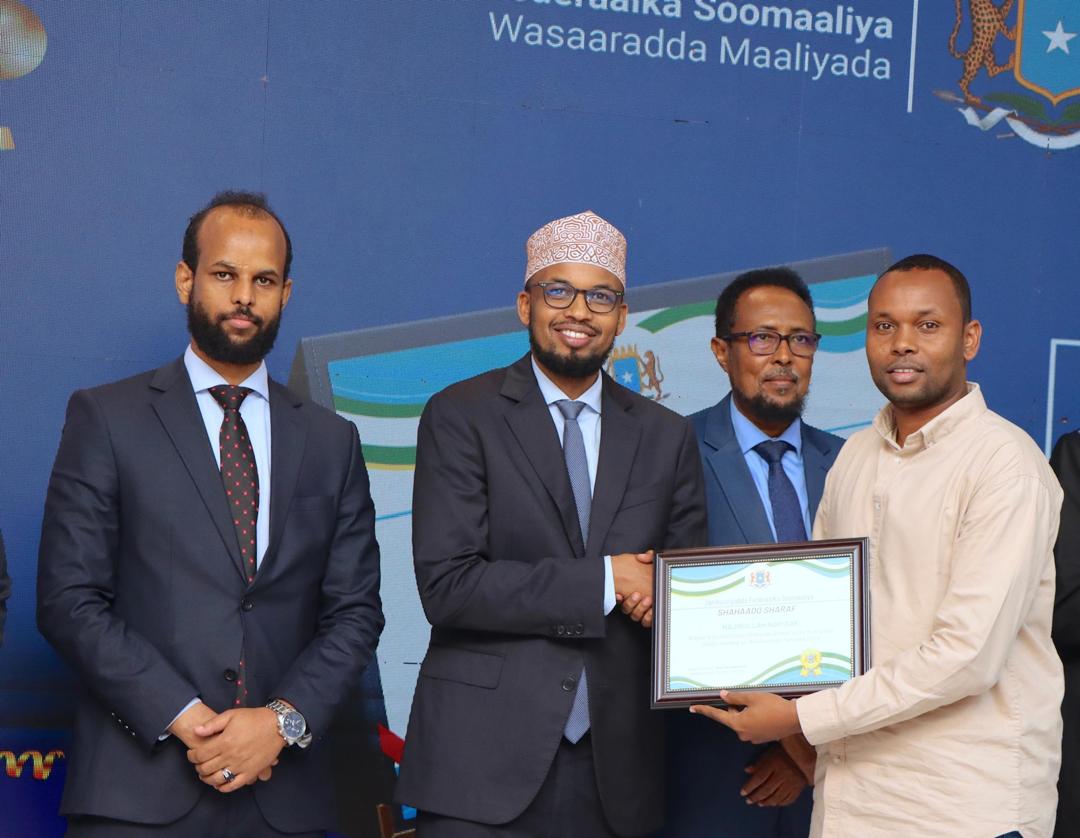
Najibullah: The publication brought significant recognition. The Ministry began involving me in major research and analysis programmes, including a study on the economic implications of declining foreign aid – an urgent issue as many donors have announced cuts – where I was assigned to lead the fiscal analysis component.
Universities also began approaching me to supervise students working on taxation. But the most meaningful outcome was the Ministry’s growing appreciation of evidence-based policymaking.
Stephanie: Has research always played an important role in policymaking within the Ministry?
Najibullah: Not at all. Historically, research was not prioritised. But as revenue mobilisation becomes more urgent, especially with aid declining, the Ministry increasingly recognises that expanding tax bases or adjusting rates requires proper analysis.
This shift is part of why, after becoming Director of the Customs Department four months ago, I created a Research and Analytical Unit within Customs. Its purpose is to use data to identify compliance gaps, risks of tax evasion, and opportunities to expand revenue. Establishing this unit is one of the successes I am most proud of.
The course was also certainly a driving force that highlighted the importance of research and motivated me to build this unit.
Stephanie: Is there one tax reform you are particularly proud of contributing to?
Najibullah: Yes, the comprehensive Income Tax Reform Programme. Until recently, Somalia was using a corporate income tax law from 1966 which no longer reflected how people earn income today. For example, someone outside Somalia could earn income from Somali sources without being taxed because they were not physically present in the country.
We shifted from a residency-based system to a source-based one, modernised tax brackets, limited excessive deductions, and aligned the law with global standards. The new Income Tax Law was passed earlier this year, and the Ministry has already kicked-off implementation. We are now taxing activities that were previously untaxed. This is a major step toward strengthening Somalia’s revenue base.
Stephanie: Looking ahead, what is your aspiration and vision for your career and for Somalia?
Najibullah: I hope one day to be in a position where I can not only inform tax reform but also implement it. Over the years, I’ve professionally progressed from junior tax officer to economist to head of the Tax Policy Division, then tax adviser to the Minister, and now Director of Customs. All throughout, my efforts have been focused on one goal: building a strong public finance system for my country that enables it to move away from foreign aid.
I believe research is the most important tool for achieving this as it provides the necessary prior analysis before initiatives are taken and serves as an evaluation tool afterward.
Stephanie: Do you have a tip for anyone facing obstacles implementing research in their government departments?
Najibullah: My advice is simple: Do not simply tell your managers that research is important. Instead, do the work and show them how that work can help them take an administrative or policy decision to make tax administration better. Present your work with benchmarks, using successful examples from other countries. Present the analysis and its findings; demonstrating the tangible benefits is the only way to influence your managers and prove the importance of research.