To inform ongoing negotiations on the taxation of cross-border services at the UN, we wrote a study on double tax relief for remote exports of services in 12 major exporting countries – China, France, Germany, India, Ireland, Japan, the Netherlands, Singapore, South Africa, the United Arab Emirates, the United Kingdom and the United States (dowload it here). The study analyses how exporting countries treat foreign taxes such as withholding taxes, digital services taxes and significant economic presence provisions imposed on services supplied remotely for the purposes of relief from double taxation.
Why this study?
How to tax cross-border services in light of the digitalisation of the economy has been a core debate in international taxation for the past decade and a half. As cross-border services are increasingly provided remotely, the status quo of international tax rules is being questioned, particularly by service-importing countries, the majority of which are lower-income countries. Most existing bilateral tax treaties allocate the right to tax such services primarily to the country of residence of the services exporter, except where connected to a local permanent establishment. The issue is at the heart of the (unresolved) negotiations of Pillar 1 Amount A at the OECD and the negotiations for Protocol 1 of the United Nations Framework Convention (UNFC) on International Tax Cooperation that started last year.
Given the relevance of these issues for lower-income countries, why did we examine their treatment in a group of predominantly high-income countries?
Most of the remotely supplied services that lower income countries would like to tax are delivered by companies that are resident in higher income countries. The consequences of different proposals to tax these services depend heavily on the interaction between the tax systems of the service importing and exporting countries. This is why understanding the tax systems of the latter is essential for developing the best policies for the former.
A concept that is central to this debate is tax incidence. In essence, it refers to the question of who economically (rather than legally) pays a tax: if a country imposes (or increases) a tax on services imported from abroad, will the foreign provider of these services bear the burden of it or will it be passed on to the country’s own consumers of the services by means of higher prices charged to them? The intention of the recent push at the UN is clearly the former, because a country would not need to engage in complex international negotiations to tax its citizens more heavily.
While the tax incidence ultimately depends on a number of factors (some of which are firm- and sector specific), one important aspect is whether taxes exceed a company’s net income or not. This can happen where a tax is levied on gross turnover or on a less-than-exact approximation of net income, as well as where tax is levied by more than one country on the same income at relatively high rates. However, sometimes higher taxation by an importing country does not need to translate into a higher tax burden at all. Here, double taxation relief rules come into play. Through these provisions, a country effectively assumes (a part of) the incidence of another country’s tax by reducing its own revenue.
There are three main methods of double taxation relief:
- Exemption: The country completely exempts the taxpayer’s foreign income from tax (sometimes under the condition that it is also taxed by another country)
- Credit: The country calculates the tax due on the taxpayer’s income but only collects what remains after subtracting the tax paid to another country from the amount
- Deduction: The country allows the taxpayer to use foreign taxes as a deductible expense, and imposes its tax only on the income that remains after the deduction
The exemption and credit methods potentially eliminate double taxation entirely, whereas the deduction method does so only partially at best. Often all three methods are part of a country’s repertoire. Which one is applied depends, among other things, on the type of income, the existence of a tax treaty, and sometimes the choice of the taxpayer. Moreover, differences in the concrete design of these rules can lead to significantly different outcomes. The effects of some of these differences are elaborated on in the article and can also be explored through this online tool.
What did we find?
In the study, we focused on services that are provided remotely. We looked at their treatment in the country of residence of exporters on four different levels:
Unilateral relief is limited for cross-border services
First, the unilateral situation: In most of the 12 countries studied, a unilateral foreign tax credit is available only for foreign-source income, while services performed domestically but delivered remotely to foreign clients are generally treated as domestic-source income. A German or Irish firm, for instance, taxed on services it supplies remotely by the country of the customer therefore usually receives no unilateral credit at home. Exceptions are India, where technical services used abroad are considered as foreign source income, and the United States, where under certain conditions domestic source income can also qualify for a foreign tax credit. In most other countries, however, a deduction is available. Non-income taxes (such as some digital services taxes) generally qualify for a deduction but not for a tax credit.
Table 1: Unilateral double taxation relief granted by the 12 countries studied for foreign taxes on remotely supplied services, by type of foreign tax and service category. Asterisks mark treatment that is uncertain or subject to conditions.
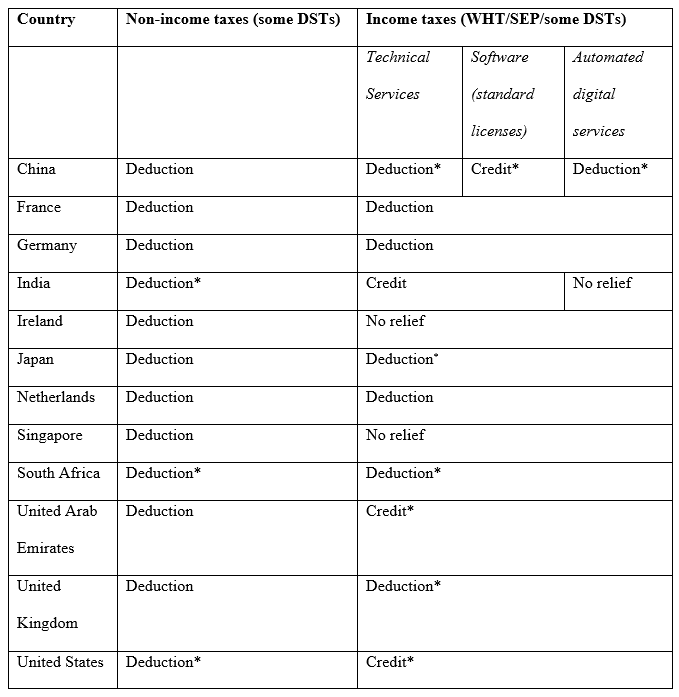
*In these cases, the treatment is uncertain or subject to conditions. Refer to the article for the detailed discussion.
Tax treaties grant foreign tax credits but largely prevent countries from taxing imports of remote services
Second, the situation under tax treaties: Tax treaties usually provide for the credit method to relieve double taxation. However, most treaties prevent the importing country from taxing remote services (even though there are disputes around the interpretation of some concepts). Yet, each of the countries studied has concluded at least one treaty with a lower income country that includes a provision that clearly allows for source taxation of technical services provided remotely and obliges the country of residence of the provider to grant a tax credit. India, and to a lesser extent South Africa, stand out because many of their treaties contain such provisions.
Foreign tax credit calculations are more generous in some countries than in others
Third, how a foreign tax credit is concretely calculated: This matters for the limited number of cases where a credit is available for remote services unilaterally or under a treaty. It will also matter if Protocol I of the UNFC provides for a foreign tax credit. The systems of the countries we studied vary significantly. The Netherlands and Japan are on the more generous end, since they allow taxpayers to cross-credit income from different sources and countries, carry forward unused credits, and give the taxpayer the choice of opting for a deduction, where this is more beneficial. France, India and South Africa are among the more restrictive; China, Germany, Ireland, Singapore, the United Arab Emirates, the United Kingdom and the United States combine generous and restrictive features. The more restrictive a system is, the more likely it is that other countries’ taxes will not be fully credited.
Practical issues can prevent resolution of double taxation
Finally, we looked at practical issues. Among others, several practitioners whom we interviewed mentioned that even where a tax treaty applies, double taxation can persist, because the importing and exporting countries disagree on the income category in which a transaction falls, for example business income or other income or royalties, because the tax treaty was not properly applied, or due to timing mismatches.
What does this mean for Protocol 1 of the UNFC?
The existence of unilateral relief rules and countries’ incentives to provide them underpins Tsilly Dagan’s famous argument about the Tax Treaties Myth (according to which the purpose of tax treaties is not primarily to alleviate double taxation, but rather to redistribute taxing rights). For services provided remotely the argument holds somewhat less, as countries tend not to alleviate double taxation entirely under their domestic law.
Considering also the existence of disputes on the application of tax treaties highlighted above, this means that while the current regime provides for a skewed distribution of taxing rights and can be strategically exploited leading to double non-taxation, there are also circumstances in which double taxation is not prevented. A new multilateral solution that allows importing countries to tax, eliminates double taxation and is considered fair by all countries involved might overall facilitate rather than hamper cross-border trade.
The case of the United States merits particular attention: Among the countries studied, the United States is – surprisingly perhaps – among the more liberal ones, as it grants a foreign tax credit even for income it does not consider as foreign source. There have been recent attempts by the Treasury to abolish this treatment, but these have been postponed because of protests by affected businesses. For the negotiations of the UNFC’s Protocol I this is probably good news: countries that have not concluded a tax treaty with the US can already expect that taxes imposed by them can be credited, so the US’ absence from the negotiations is less of a problem.
The findings also speak to the debate around net versus gross taxation. While the analysis shows that gross taxation can lead to double taxation even where foreign tax credits apply, it also shows that the likelihood of this happening depends on the rules for calculating these credits. Their design is currently in the hands of the exporting countries. Yet, concrete design choices such as cross-crediting and treatment of excess credits could also be negotiated between countries. Protocol I of the UNFC could, for instance, prescribe a minimum level of generosity of foreign tax credit rules, although rules would need to consider the differences in capacity of tax administrations.
Further reading on the UNFC
ICTD has been closely monitoring the developments around the negotiations for a UN Framework Convention on International Tax since its inception. View this webpage to see more of our research and analyses on the topic, which include a three-part reading list to get you up to date on what issues are being debated regarding the Convention and Protocols 1 and 2.